invisiblepalmistryMAGIC ARTIST MIRRORBehind the reflection ↓
CAMERA EXPERIENCE / READY TO STARTSomeone has been here before you.

Someone left you a message.
The mirror is keeping it secret.

ALLOW THE CAMERA. TRY BLOWING GENTLY TOWARDS IT. SOMETHING IS WAITING IN THE MIST.

Try blowing gently towards the camera. Someone left you a message.

Camera is optional. In camera mode, blow gently to mist the glass. Your index finger reveals clear handwriting through the mist. Processing stays on this device.

About the sensing

The camera supplies a mirrored reflection. A sustained rounded-lip blowing gesture creates mist at the detected mouth. Ordinary mouth movement is filtered, though this remains a visual estimate rather than a physical measurement of breath. Hand landmarks follow an extended index fingertip, creating a small moving light that wipes the hidden handwritten strokes clear in the condensation. The visible strokes show the unblurred camera image underneath; they have no assigned ink colour. The flame is virtual: no lighter is required. Camera access starts only when you choose it and stops when you turn it off or leave.

Microphone access is optional and requested separately. No camera or microphone recordings are saved or uploaded. The pointer study uses an abstract silver surface, not a simulated person.

Explore what the mirror holds ↓

01 / BACKGROUND & RESEARCH MOTIVATION

Creative expression.
A more positive reflection.

The original project investigates how drawing, mirror-gazing and interactive feedback might support positive self-expression and connection.

Why creative expression?

The original literature review discusses art-making as a way to support emotional wellbeing. It cites research on a reduction in cortisol after 45 minutes of creative activity, and accounts of relaxation and reduced anxiety across different levels of artistic experience (Siddiqui, 2024; Medical Daily, 2016).

This is the motivation for inviting people to draw and leave uplifting messages on a mirror.
Why a mirror?

The project also begins with an everyday observation: people doodle, write affirmations and leave messages on glass in buses, elevators and waiting rooms. Combining that impulse with a reflective surface creates an opportunity for personal expression and social interaction.

The original research notes consider frequent mirror use, appearance-related insecurities and positive self-reflection (Within Health, 2023).

Why interaction?

In the original proposal, tactile and visual feedback make the visitor an active participant. Brushes, colours and erasing let them create directly on the mirror, while the storyboard explores encounters in shared spaces.

The current version develops this idea through breath, fingertip light and discovering positive handwritten messages.

Summary of the artist’s original literature review and design rationale. Author–date references are retained as listed in the 2024 design notes ↓. The cited art-making research motivates the design; the mirror’s own effects require separate evaluation.

02 / THE IDEA BEFORE THE INTERFACE · 2024

From looking at yourself
to leaving something of yourself.

The original proposal began with a familiar gesture: making marks on glass. Could a mirror become a space for expression and connection?

What if a reflection
could become a conversation?

In buses, elevators and waiting rooms, glass can become an informal canvas. The project takes that everyday impulse — a doodle, a word, a small message — into an interactive mirror.

The aim is to invite a moment of creativity, positive self-reflection and contact with others.

Follow the original encounter ↓
01 Looking, wondering, imagining

The original ideation explored the mirror’s cultural history: an object associated with wonder, protection and invisible powers, as well as appearance. This led to the idea of a mirror that holds more than an image.

Reading in the original proposal: Katy Kelleher, 2019 ↗
02 The self through other people

Cooley’s looking-glass self and Lacan’s mirror stage informed the initial inquiry into reflection and identity. Here, these ideas prompt a design question: can a surface used to assess appearance also invite expression?

03 A social surface

The original user-research notes considered frequent mirror use, appearance-related insecurities, social media and positive self-reflection. The design responded with creative marks and shared encounters, rather than another way to judge an image.

These are motivations documented in the original proposal, not findings from a clinical evaluation of this browser experience.

03 / SIX MOMENTS, ONE MIRROR

Before the code,
there was an encounter.

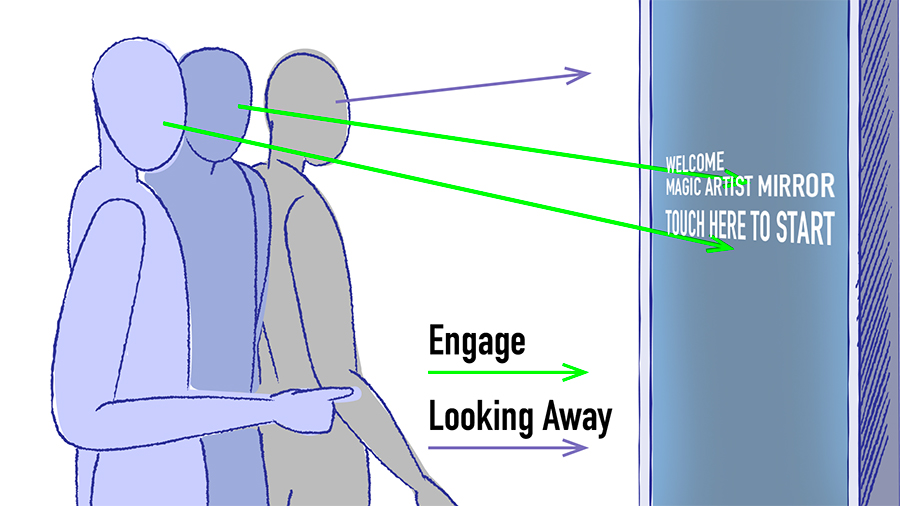
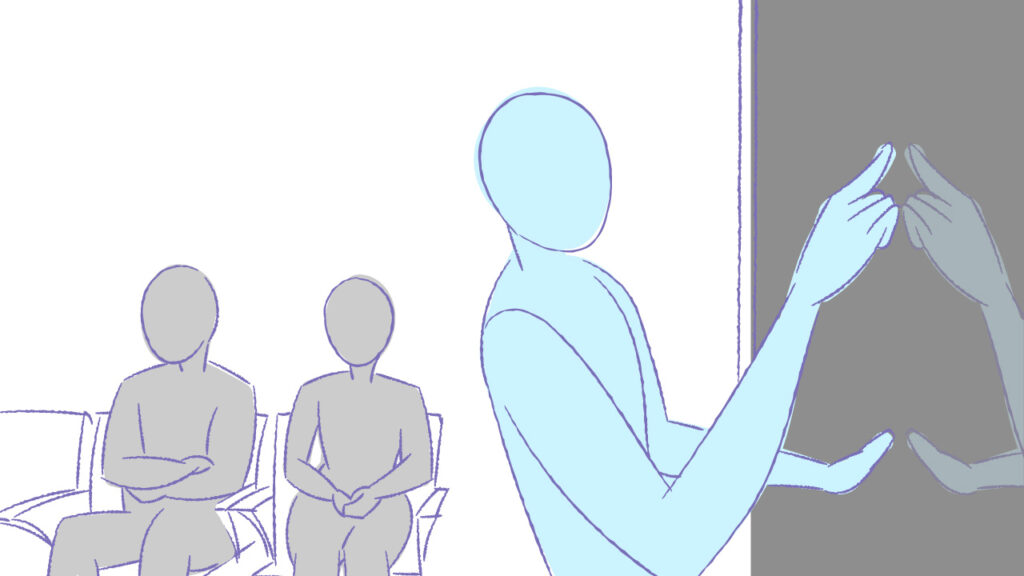
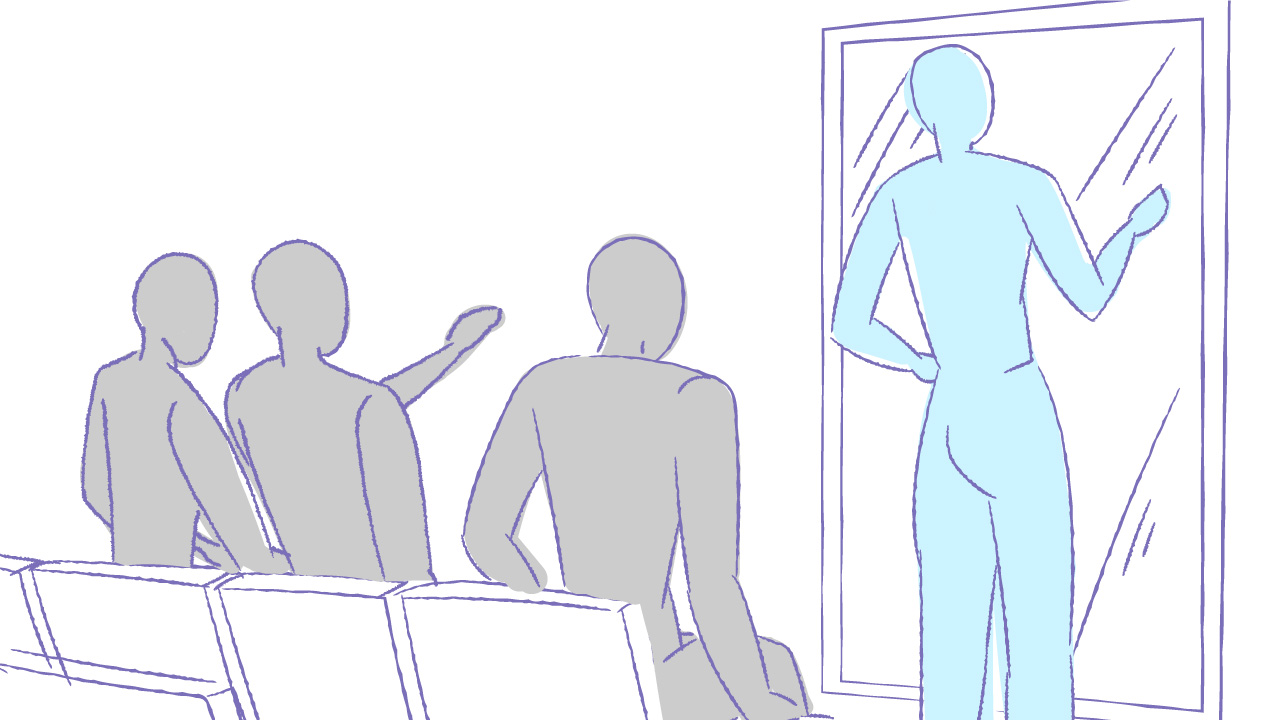
Explore the six scenes from the original storyboard. These are imagined design scenarios, not recordings of a deployed installation.

YongHong Chen’s original storyboard: The Waiting Room GlowTHE WAITING ROOM
01 / 06

The Waiting Room Glow

In a dim psychotherapy waiting room, a softly glowing mirror catches the attention of a patient arriving with slumped shoulders.

All six storyboard illustrations are drawn by YongHong Chen and reproduced from the original 2024 project. Select a scene to explore the original drawing.

04 / THE DESIGN DESK

Inside the
design process.

Three original records, one evolving proposition.
Select a record, then move your light across it.
Open the original to examine the details.

Artist’s original 2024 mirror concept sketch01 / THE OBJECT
2024 · ORIGINAL CONCEPT SKETCH

Before it could answer.

A designed mirror, imagined as a place to make marks rather than judge an appearance.

Original mirror interface wireframe with drawing tools02 / THE INTERFACE
2024 · ORIGINAL WIREFRAME

From tools to gestures.

The early concept used brush and colour controls. This web experiment explores breath, touch and light instead.

Original speculative storyboard of the mirror experience03 / THE ENCOUNTER
2024 · SPECULATIVE STORYBOARD

A small pause in a public place.

The storyboard imagined a quieter moment in shared spaces. It is a design scenario, not documentation of a deployed installation.

Original drawings and scenarios from the artist’s 2024 design material ↓. The browser experiment is a new iteration.

05 / ORIGINAL 3D DESIGN STUDIES · 2024

Imagining the
physical mirror.

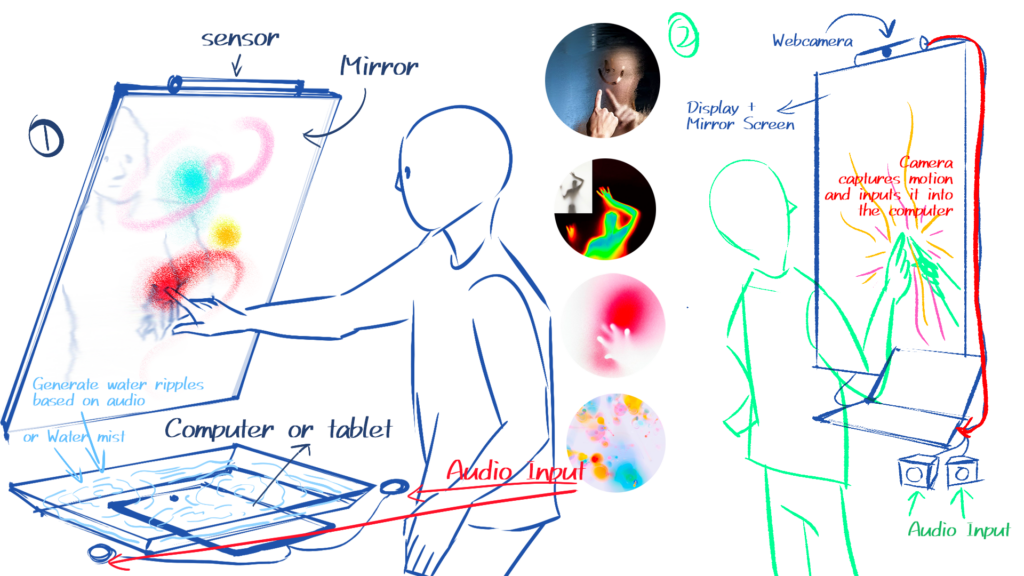
The artist’s original 3D visualisations explore the mirror, sensor, audio input and computer or tablet. Move the light across an image; select it to inspect the original.

06 / FROM PROPOSAL TO THIS SCREEN

The tools changed.
The invitation stayed.

Select a gesture to see how this iteration translates a physical mirror into a browser experience.

PRESENCE → REFLECTION

The screen becomes the mirror.

The original proposal imagined a touch-sensitive mirror with LED lighting and a camera. This version uses a mirrored live camera feed that fills the screen, with processing kept on your device.

The original technical plan ↗

The 2024 proposal considered p5.js for visuals, ml5.js for gesture detection and Tone.js for music, with TouchDesigner, MediaPipe, Leap Motion, SuperCollider and AR as possible further explorations. Its wireframe included brushes, colours, an eraser, Undo, Save and Share.

This browser iteration uses MediaPipe face and hand landmarks with layered canvas surfaces. Its focus is breath, a fingertip light and discovering authored messages. Music, saving, sharing and a physical lighter are not implemented features.

07 / AN OPEN EXPERIMENT

The mark fades.
The moment stays.

This work explores attention, self-expression and the small ritual of leaving a trace. The next question is how people discover its gestures — and what they choose to leave behind.

Return to the mirror ↑
Research & development notes

The original project brought together mirror-gazing, creative expression, the looking-glass self and the mirror stage. These are starting points for a design inquiry, not evidence of a clinical benefit.

This version combines a live camera reflection, face and hand landmark sensing, and layered surface masks. Pointer and touch remain available without a camera. Flame-location tracking with a physical light source is a future experiment; this version uses a virtual light.

Next evaluation: gesture discoverability, false breath triggers, hand-tracking stability, and whether participants understand the relationship between fading marks and self-expression.

A small light travels with you.