
Garbage Collection Echo: A Data-Driven Interactive Audio-Visual
“Garbage Collection Echo” is an innovative interactive audio-visual project. It transforms environmental data and waste collection visuals into a sensory narrative. Using images and CSV data from diverse locations, it employs p5.js and sound libraries to create dynamic visuals and sounds. Inspired by sound art and data sonification, it aims to raise ecological awareness through art.
the artist
September 13, 2025
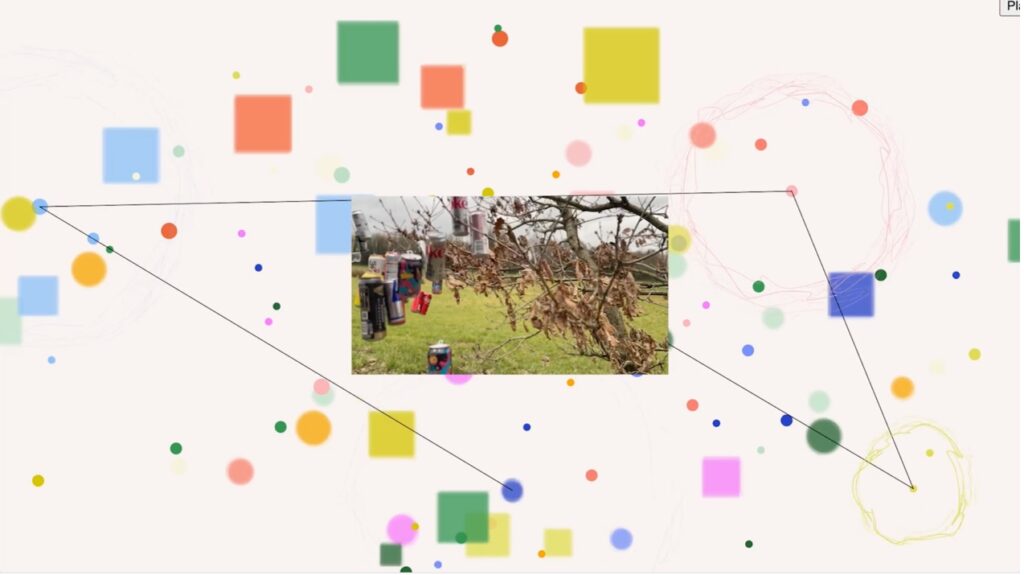
Image 1 is a screenshot of the work of Garbage Collection Echo: A Data-Driven Interactive Audio-Visual
Introduction
“Garbage Collection Echo” is an interactive audio-visual experience designed to transform environmental data and visual records of waste collection into a compelling sensory narrative. The project uses over 100 images and CSV data collected from rural and coastal regions of China, Ireland, Morocco, and Poland. This paper documents the conceptual basis, technical implementation, and artistic choices that guided the development of this work, as well as its grounding in relevant digital arts and sound theory.
https://youtu.be/WjJK9yOVpVk?si=-yWOrhkCV19lVPSQ
This work draws inspiration from key theories in sound studies and data-driven art, with a primary focus on environmental soundscapes. Influenced by Pierre Schaeffer’s musique concrète, the project employs field recordings of natural and human-made sounds—including bird calls, water flow, cars’ noise, and garbage interaction—captured during different times of the day and under various weather conditions in Lee Field Park, Cork (Schaeffer, 1966). This approach draws inspiration from Julie Freeman’s use of data to create biologically-inspired works that combine data visualization and sound synthesis, raising awareness of environmental conservation. Similarly, I aim to use this approach to awaken people’s awareness of the unconscious habits and the unconscious creation of waste in their daily lives. Additionally, it incorporates the aleatoric methods of John Cage, introducing randomness into both the sound and visual sequences (Cage, 1961).
From the visual perspective, the piece draws on the abstract geometries of Kandinsky, the rule-based systems of Vera Molnar (Molnar, 1974), and the organic forms seen in the works of Impressionist painters like Monet. The interactive aspect of the piece encourages users to trigger sound and visual responses by interacting with the data points, blending logic with emotion. This work uses photographs of environmental data gathered from various locations, data-driven programming process in P5.js and processing on https://twotone.io/.
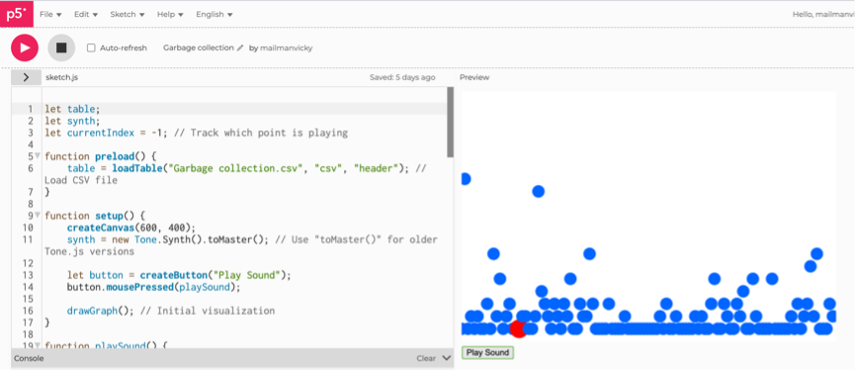
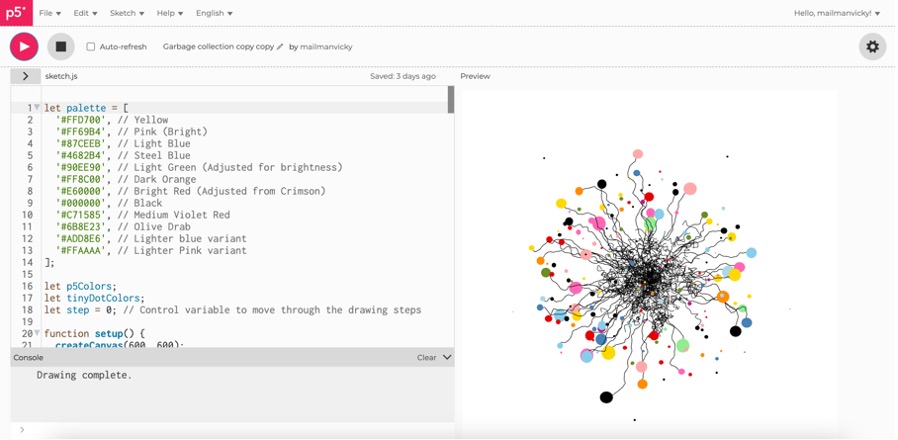
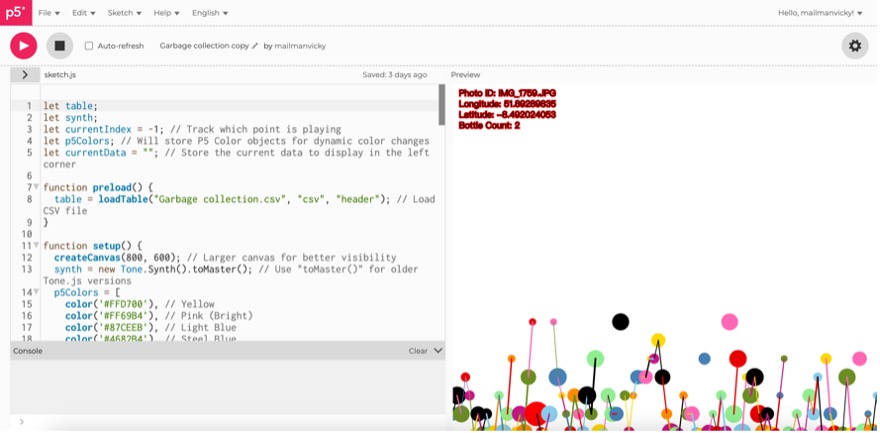
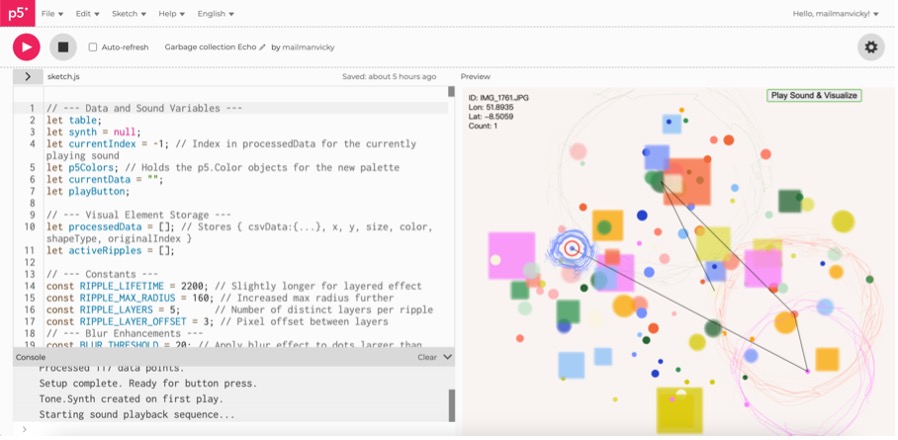
Image 2, 3, 4, 5 Screenshots of P5.JS online programming
Technical Implementation
The project was built using p5.js, HTML, and CSS. It reads data from a custom CSV file and image set labeled with GPS coordinates, dates, and descriptive tags. Each image corresponds to a specific data point, which the program visualizes as an abstract form—either in Kandinsky-inspired geometric composition and the effect of blurred hazy and water ripples, based on data of pictures.
The audio component is built using the p5.sound library. Sounds are mapped based on data attributes such as waste category, location, and collection frequency.
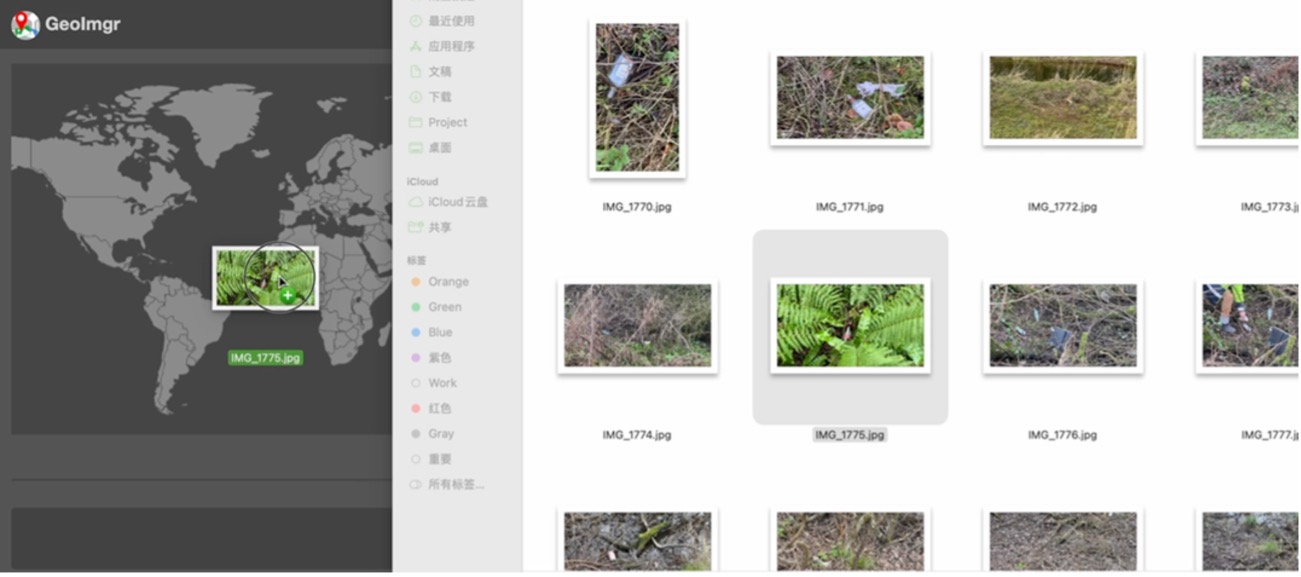
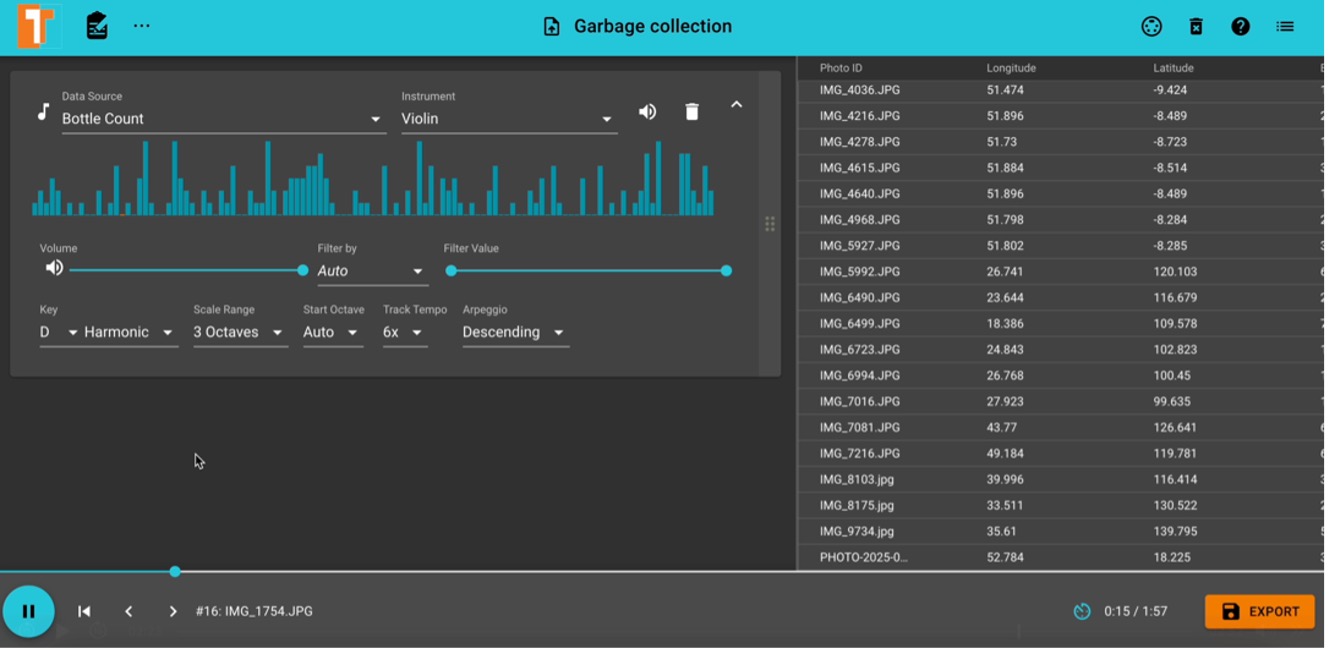
Image 6 Use https://tool.geoimgr.com/ to extract the geographical location of the photo
Image 7 Use https://twotone.io/ to generate sound.
Learning from ‘Sounds of the Squirrels’
The “Garbage Collection Echo” project drew inspiration from the “Sounds of the Squirrels” project, which offered valuable programming insights for mapping data to auditory and visual outputs. In the project, the color of each squirrel decides which musical note is played, the location can make the note higher, and the squirrel’s actions change how the sound rises and falls. The ID and other details mainly control the order of playback and the text shown on the screen, creating a simple interactive experience that combines sound and visuals.
In contrast, “Garbage Collection Echo” introduces greater complexity through conditional logic for data filtering and multi-layered sound compositions triggered by single data points. It integrates GPS-stamped images and dynamically generates visuals using blend modes, bezier shapes, and custom brushes, drawing inspiration from both Western abstraction and Chinese ink art. Although the final version does not visually use the brush and ink style.
Key Similarities:
- Data Loading: Both projects use the preload() function and loadTable() to load CSV data, ensuring it is available before setup.
- Data Processing: Both convert raw CSV data into object arrays for easier access, with “Garbage Collection Echo” extending this by calculating visual properties.
- Data Storage: Both use global arrays (parsedSquirrels vs. processedData) to store processed data for subsequent functions.
- Event Triggering: Both projects sequentially process data points to trigger events, though “Garbage Collection Echo” uses pre-scheduled events with Tone.js for precise timing.
- Data Sonification: Both map data attributes to sound parameters, with “Garbage Collection Echo” using bottle counts to determine frequencies.
- Current Item Tracking: Both use an index variable to track the current data point for display and interaction.
- Information Display: Both projects display information about the current data point using text in the draw function.
- Button Interaction: Both use createButton() and event handlers to initiate interactions.
Key Innovations in “Garbage Collection Echo”:
- Sound Library: Utilizes the more advanced Tone.js library for sound generation.
- Visual Complexity: Emphasizes dynamic visual effects like randomness, shape variation, and ripple animations.
- Event Scheduling: Employs Tone.js Transport for precise scheduling of all events at playback start.
- Visual Updates: Relies on the draw loop for continuous visual updates, enhancing the dynamic nature of the piece.
This work contributes to the discourse in digital arts and humanities by showing how environmental and social concerns can be artistically reinterpreted through data. It embodies what Rodaway (1994) calls “sensuous geographies,” wherein sound becomes a method for navigating and understanding place.
Furthermore, by employing Cage’s indeterminacy and Molnar’s algorithmic logic, the project questions the role of authorship and control in generative art. In this way, it bridges Eastern philosophies of nature (For example, John Cage’s works are expressed in terms of randomness, silence and emptiness according to the I Scriptures and Buddhism.) with Western digital aesthetics, and merges real-world activism with artistic expression.
Conclusion “Garbage Collection Echo” offers a space where code, sound, image, and data converge to raise ecological awareness. By allowing audiences to interact with data through art, it proposes a more empathetic relationship with our shared environment. If I have time in the future, I will continue to optimize the work of Garbage collection Echo. For example, when interacting with the mouse, that is, the corresponding data will appear on which element the mouse clicks, so that it will make it easier for users to find the specific data they want. In the spirit of Cage, it listens deeply to the world; and in the deconstructed vision of Molnar, it lets rules guide creation without limiting beauty.
References
-
Ikeda, R. (2008). Test Pattern. [Visual and Sound Artwork]. Available at: https://www.youtube.com/watch?v=cywFvcRR-QI [Accessed 5 Apr. 2025].
-
Cage, J. (1961). Lecture on Nothing. [Text]. Available at: https://www.youtube.com/watch?v=3F6gtuCk_44 [Accessed 5 Apr. 2025].
-
Molnar, V. (1974). Generative Computergraphik. [Book]. Available at: https://www.youtube.com/watch?v=8tNESHtfkr0 [Accessed 5 Apr. 2025].
-
KickingKeys. (2022). Sounds of the Squirrels. [Interactive Art Project]. Available at: https://editor.p5js.org/kickingkeys/sketches/KlBe8HdSY [Accessed 5 Apr. 2025].
-
Geotag Photos Online. (n.d.). Geotagging of images. [Online Tool]. Available at: https://tool.geoimgr.com/ [Accessed 5 Apr. 2025].
-
TwoTone. (n.d.). Data sonification and data-driven music. [Online Application]. Available at: https://twotone.io/ [Accessed 5 Apr. 2025].
-
Rodaway, R. (1994). Sensuous Geographies. [Book]. Routledge.