Visible Bodies, Invisible Power: A Feminist Data Study of Classical Chinese Ghost Stories
Ghost stories are supposed to scare us. But in Strange Tales from Make-Do Studio (Pu, 1989) and Into the Porcelain Pillow: 101 Tales from Records of the Taiping Era (Li Fang et al., 1998), the fear isn’t only about demons—it’s about women’s bodies. A goose cage becomes a prison. A painted skin becomes a mask. These aren’t just plots; they are wetlands of discipline. My project asks: what happens if we trace these words, count their emotional weight, and then give them physical form?
the artist
August 26, 2025
Why ghost stories?
Ghost stories are supposed to frighten us with demons, monsters, and the uncanny. But in the Chinese classics, fear often hides elsewhere: in women’s bodies.
In “Painted Skin”, from Strange Tales from Make-Do Studio (Pu, 1989), a woman is literally peeled apart, her flesh turned into a mask to deceive men. In “A Ride in a Goose Cage”, from Into the Porcelain Pillow: 101 Tales from Records of the Taiping Era (Li Fang et al., 1998), a woman is trapped and carried from one man to another, her body reduced to an object of exchange.
These are not just fantastical plots. They are instructions—grammars of discipline and control written into narrative form. My project set out to ask: how do words become cages, and how might we make those cages visible again?
https://youtu.be/lXWW6GnYJeg
How I worked
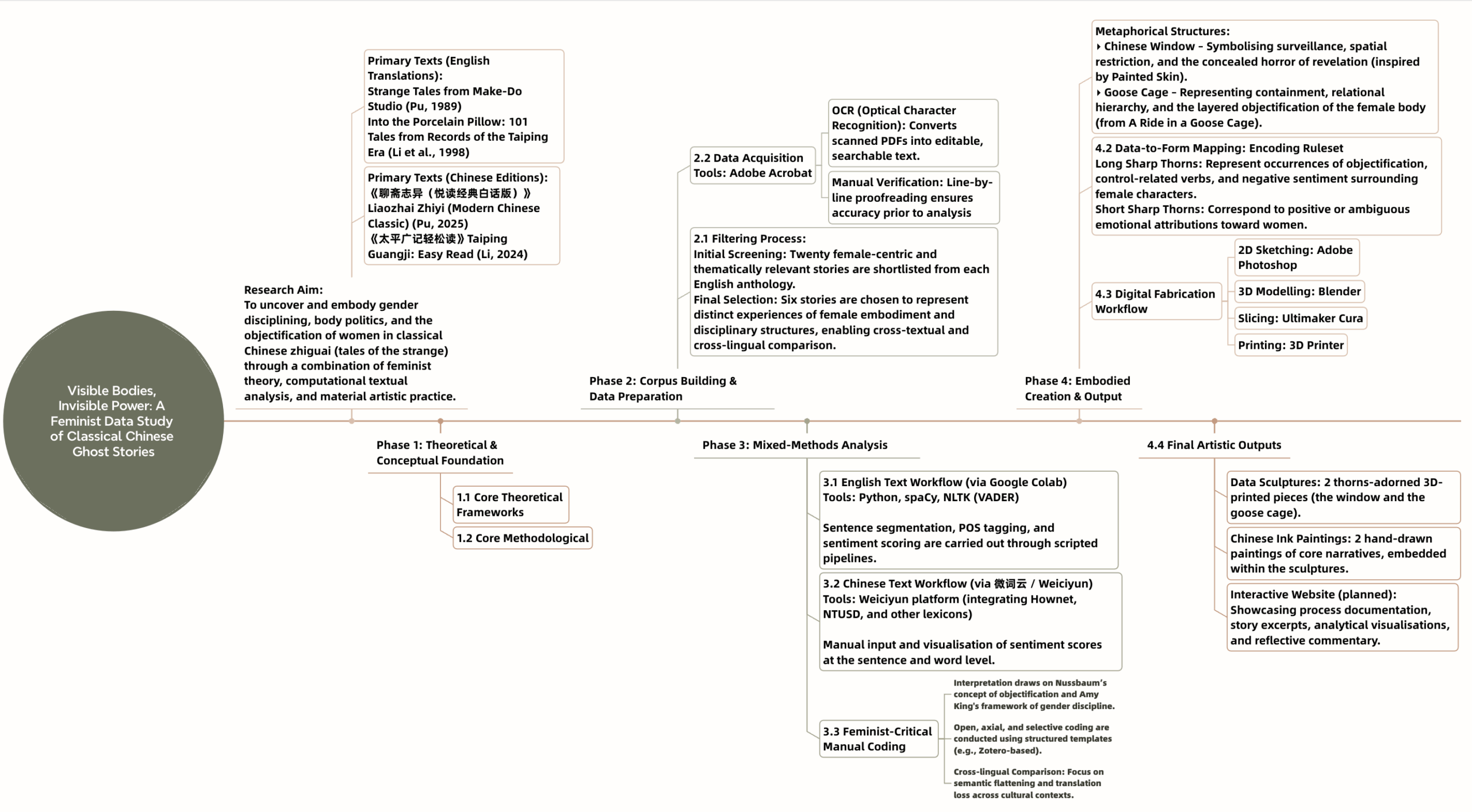
The journey moved step by step:
-
First, I digitised both collections—correcting OCR mistakes and aligning Chinese with their English translations.
-
Then I tagged the words: which ones described the body, which ones imposed discipline, which ones objectified women.
-
Using sentiment analysis (VADER for English, WeiCiYun for Chinese), I counted the emotional charge of each story—positive, negative, and neutral.
-
Finally, I translated those numbers into objects: 3D-printed cages and windows filled with thorns. Each thorn marked a word; each cluster mapped an emotion.
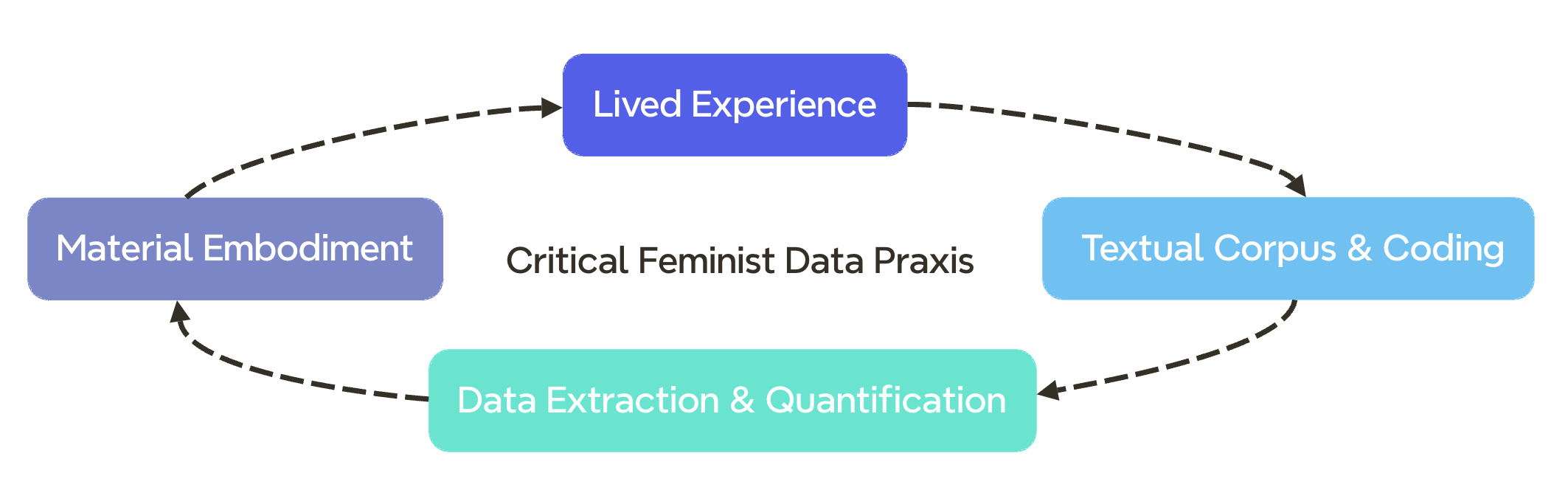
My methodological path followed a clear arc: from text to data, from data to matter, and finally from matter back to the body. This movement was not only technical but also theoretical, tracing how language becomes code, how code becomes objects, and how those objects return us to embodied experience.
What the data showed
The contrast was stark. On average, tales in Strange Tales from Make-Do Studio carried more negative words and sentences—up to 33% in “Painted Skin”—than the quieter, more “neutral” tone of Porcelain Pillow.
This matters. The harsh vocabulary of Liaozhai made violence explicit, while Porcelain Pillow normalised objectification under a calmer voice. Both revealed discipline, but in different registers: one dramatic, one insidious.
Explore: hover over “Painted Skin” or “A Ride in a Goose Cage” and compare how negativity and positivity diverge.
From text to matter
But words alone can only go so far. Computers can count them, but they cannot feel them. To bridge that gap, I turned text into objects.
-
The Window with Thorns encodes the sharpness of negative words in Painted Skin. Looking through it means looking through violence.
-
The Goose Cage with Thorns materialises the layered constraints of A Ride in a Goose Cage. What was metaphor on paper becomes matter in the hand.
By materialising text, the invisible power of language becomes visible—and tangible.
3D modelling of The Window with Thorns (Data visualization from the text, Painted Skin, (Pu, 1989)).
3D modelling of The Goose cage with thorns (Data visualization from the text, A Ride in a Goose Cage, (Li Fang et al., 1998)).
What this means
This project stands at the intersection of feminist theory (Butler, Federici, Nussbaum), digital humanities, and critical making. It shows how classical ghost stories disciplined women’s bodies, how translation softened or concealed that violence, and how physical artefacts can re-awaken us to the textures of power hidden in narrative.
The work is both analysis and protest: a way to count, to code, but also to touch and to feel.
Reference:
-
Butler, J., 1999. Gender trouble: feminism and the subversion of identity. New York: Routledge.
-
Federici, S., 2023. 超越身体边界: 在当代资本主义中反思、重塑和重夺身体. Translated by J. Wang. Beijing: Guangqi Press. (Original work published 2020 as Beyond the Periphery of the Skin: Rethinking, Remaking and Reclaiming the Body in Contemporary Capitalism.)
-
Gaviria, A.R., 2008. When is information visualization art? Determining the critical criteria. Leonardo, 41(5), pp.479–482.
-
Knight, K.B., 2018. ‘Danger, Jane Roe!’: material data visualization as feminist praxis. In: E. Losh and J. Wernimont, eds. 2018. Bodies of Information: Intersectional Feminism and the Digital Humanities. Minneapolis: University of Minnesota Press, pp.3–24. doi:10.5749/j.ctv9hj9r9.4.
-
Li, F., et al., 1998. Into the porcelain pillow: 101 tales from Records of the Taiping Era. Beijing: Foreign Languages Press.
-
Li, X., 2024. Taiping Guangji qingsong du《太平广记轻松读》. Beijing: China Literature and History Press.
-
Nussbaum, M.C., 1995. Objectification. Philosophy and Public Affairs, 24(4), pp.249–291.
-
Pu, S., 1989. Strange tales from a make-do studio. Translated by D.C. Mair and V.H. Mair. Beijing: Foreign Languages Press.
-
Pu, S. [蒲松龄], 2025. Liaozhai zhiyi (Yuedu jingdian baihua ban)《聊斋志异(悦读经典白话版)》. Translated by X. Jia. Beijing: Manbanpai Culture Co., Ltd.